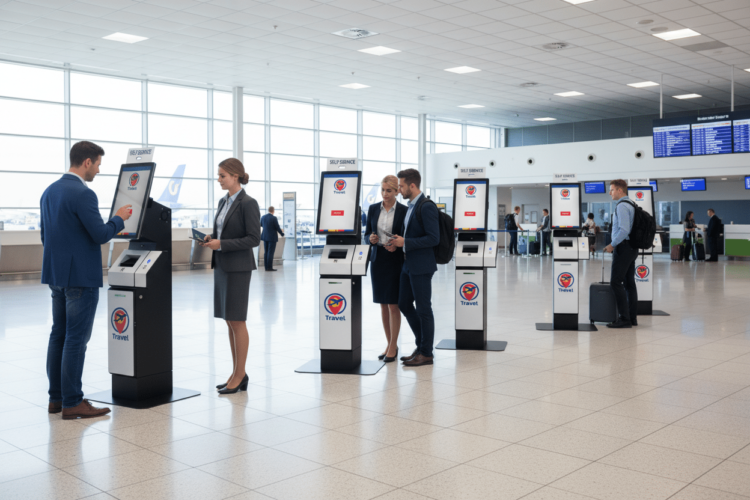
Airports face a constant challenge: verify identity with complete accuracy while moving passengers through quickly and calmly.
For many years, improving security meant adding more steps. More checkpoints. More document reviews. More waiting.
But today’s travelers expect something different. They expect digital systems to work smoothly. They expect speed. And increasingly, they expect the system to recognize them.
The real challenge is not whether to validate identity. It’s how to do it in a way that keeps security strong while improving the passenger experience.
Next-generation check-in sits at that intersection, where AI-driven identity platforms and thoughtfully designed self-service kiosks work together to create secure, seamless first impressions.
Identity Should Feel Natural
Check-in is more than a process. It sets the tone for the journey.
It influences whether a passenger feels confident or anxious. In travel, small delays can quickly increase stress.

Historically, airport identity verification felt very mechanical:
Present your passport.
Scan your boarding pass.
Wait for approval.
Today, that interaction can feel very different.
With AI-enabled identity systems, kiosks can combine biometric matching, mobile credentials, and document validation into one guided experience. Instead of stopping passengers at each step, the identification verification can recognize and move them forward smoothly.
When airport identitification verification technology feels simple and intuitive, security builds trust instead of tension.
From Static Checkpoints to Intelligent Systems
Traditional kiosks followed fixed workflows. Every passenger completed the same steps in the same order.
Modern systems are more adaptive.
AI platforms can analyze real-time data such as:
- Flight schedules
- Passenger volume
- Congestion patterns
- Connection times
This allows airports to anticipate busy periods and adjust workflows before lines grow long.
Passengers can be redirected automatically. Biometric validation can reduce processing time. Staffing can shift to areas that need attention.
The goal is not just faster throughput. It is smoother movement through the terminal.
Security standards remain high. Friction decreases.
Airport Identification Verification Technology Without Extra Friction
Biometric verification, passport scanning, and real-time credential matching are becoming standard in regulated travel environments such as TSA Checkpoints. But technology alone does not improve the experience. Design matters.
When implemented carefully:
- Cameras align naturally at standing height
- Document scanners read quickly and accurately
- Secure credential readers integrate cleanly into the kiosk
- On-screen prompts adjust to language preferences
- Confirmation messages are immediate and clear
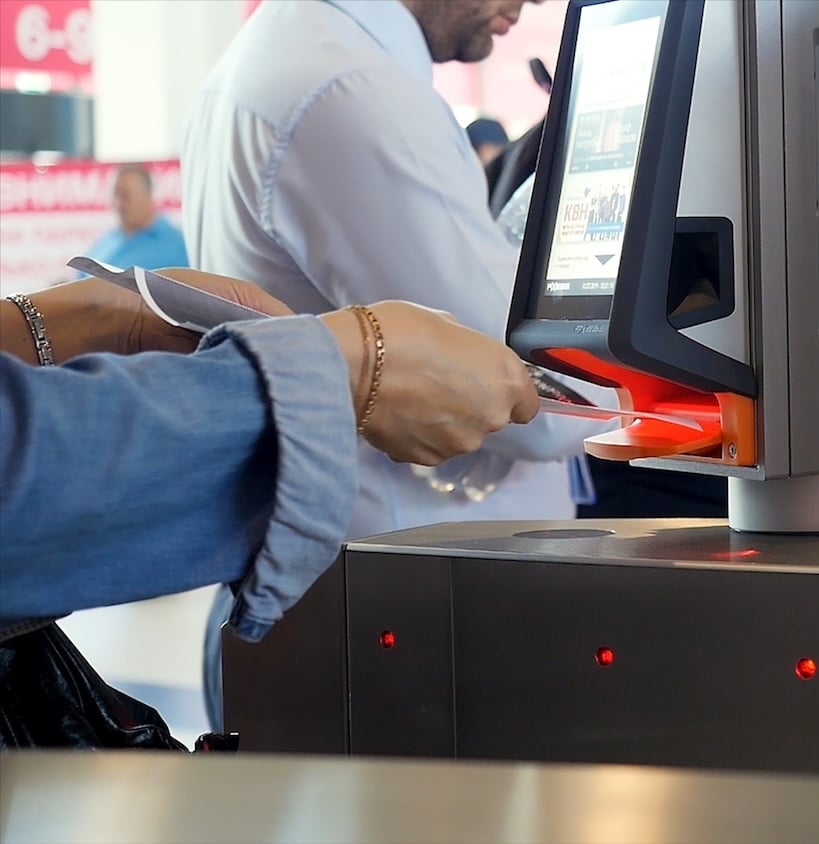
AI systems can also reduce repeated steps. Returning travelers may be recognized through approved credentials. Mobile identity data can be validated before a passport is scanned.
The difference between “Stop and prove who you are” and “Step forward — you’re recognized” is subtle but powerful.
In airports and border-controlled facilities, that difference enhances the experience.
The Infrastructure Behind the Experience
AI software may guide decisions and manage workflows, but in regulated travel environments, hardware determines whether that intelligence performs reliably at scale.
Airports and border-controlled facilities operate 24/7 under strict security and compliance standards. Biometric verification, credential authentication, and document validation require precise camera placement, certified scanners, secure credential readers, and dependable edge computing power. If any one of these components fails during peak passenger traffic, the experience suffers, and security risks increase.
In these environments, enterprise OEM computing platforms are often evaluated to support biometric processing, real-time credential matching, and AI workloads running at the edge. Platforms such as Dell OEM systems are commonly selected in travel and public-sector deployments because they offer lifecycle stability, enterprise-level support, and global availability.
Secure credential and identity components also play a critical role. Enterprise providers such as HID supply authentication and credential technologies used in regulated environments. These components must integrate seamlessly into kiosk systems while meeting strict durability, security, and accessibility requirements.
Olea does not build biometric matching software or identity orchestration platforms. Instead, we design and engineer the physical systems that allow those technologies to function reliably in high-traffic, compliance-sensitive environments.
That means:
- Integrating biometric modules, credential readers, scanners, and secure enclosures into cohesive kiosk solutions
- Designing for durability in 24/7 international terminals
- Ensuring ADA compliance and accessibility in public infrastructure
- Building modular systems that allow identity software to evolve without replacing entire kiosks
In travel, infrastructure should feel invisible when it works. But in regulated environments, reliability is not optional.
From Throughput to Confidence

For years, airport performance was measured mainly by one number: passengers processed per hour.
That metric still matters. But leading travel organizations are asking a broader question:
Did passengers move through the system confidently?
AI-enabled kiosks allow airports to maintain strict identity validation standards while reducing uncertainty. Predictive systems help prevent bottlenecks. Adaptive workflows remove unnecessary repetition. Clear confirmation signals reassure travelers.
Security remains strong.
The experience becomes calmer.
In high-pressure environments like airports, calm is operationally powerful.
When This Architecture Is a Strong Fit
This approach is especially relevant in environments where identity verification is mandatory and downtime creates regulatory or reputational risk.
It is commonly applied in:
- International terminals and border-controlled travel environments
- Airports integrating biometric validation with legacy airline systems
- High-throughput passenger facilities operating 24/7
- Public-sector deployments requiring enterprise-grade lifecycle planning
In these scenarios, combining AI-driven identity orchestration with enterprise OEM computing and secure credential infrastructure enables airports to maintain strict validation standards while reducing friction.
Recognition as the New First Impression
The next era of travel check-in will not remove identity validation. It will improve how it feels.
Passengers will move through environments where:
- Their credentials are anticipated
- Their language preferences are recognized
- Their path forward is clear
- Their time is respected
AI will continue to improve prediction and coordination. Self-service systems will continue to empower travelers. And thoughtfully engineered hardware will ensure these systems operate securely and reliably at scale.
The future of travel will not be defined only by shorter lines.
It will be defined by the moment identity is verified and the passenger barely notices—because the process felt natural, intuitive, and secure.