Modern identity verification technology has solved the speed-versus-security tradeoff. But the right verification stack still depends on where the kiosk is deployed.
There is tension at the heart of a cash-dispensing kiosk. Cash is the most anonymous form of payment in circulation. And yet, the machine handing it out, or accepting it, must know exactly who it is dealing with.
For operators, that tension has real stakes. Fraud liability, regulatory exposure, and user trust all depend on identity verification working correctly. And it has to work quickly, because a self-service transaction that takes three minutes to initiate is one that users will abandon.
For a long time, those two requirements, rigorous and fast, seemed to pull in opposite directions. That is no longer the case. Advances in AI-driven document recognition, biometric matching, and liveness detection have made it possible to verify a user’s identity in under 30 seconds at a kiosk. The technology has genuinely caught up to the promise of self-service cash.
But speed is only part of the picture. Cash kiosk identity verification varies significantly depending on the industry it operates in, the regulatory environment it must satisfy, and the population it serves. A kiosk in a county jail release facility and a kiosk in a hotel lobby are both dispensing cash. The similarities largely end there.
This article explains how identity verification works at a cash kiosk and how that process should be configured for the industries where self-service cash transactions are most common.
What a Cash Kiosk Does to Confirm Who You Are
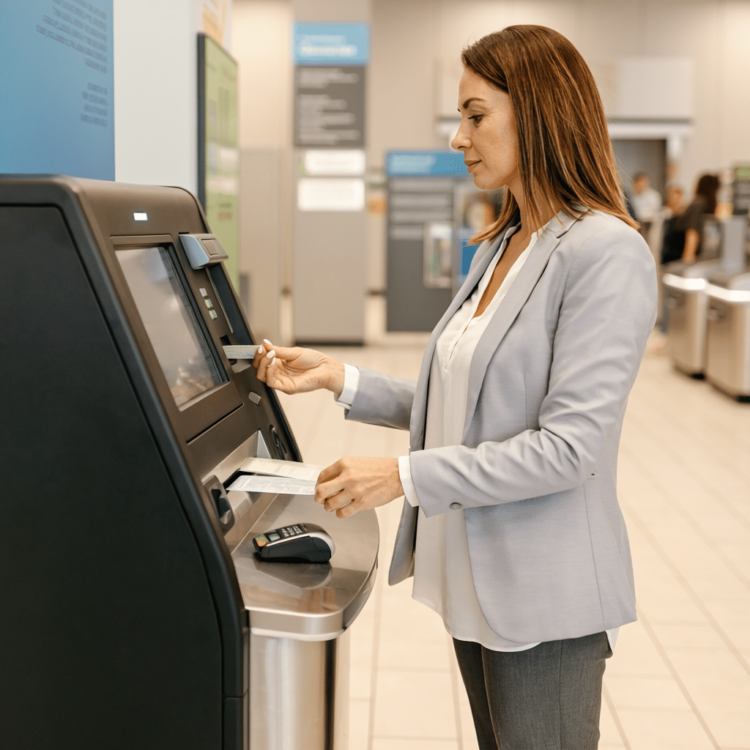
When a user approaches a cash kiosk to initiate a transaction, whether depositing a check, withdrawing funds, or cashing out, the kiosk typically runs through a layered verification process. The specific steps and their sequence vary depending on the software platform the kiosk operator has deployed, but the core layers look like this:
Document Capture and OCR
The user presents a government-issued ID — a driver’s license, state ID card, or passport — to the kiosk’s document scanner. Optical character recognition (OCR) software reads the data fields on the ID: name, date of birth, address, and ID number. At the same time, the system examines the document itself for authenticity indicators: microprint, UV patterns, barcode data, and other security features that distinguish a legitimate ID from a counterfeit one.
Biometric Facial Matching
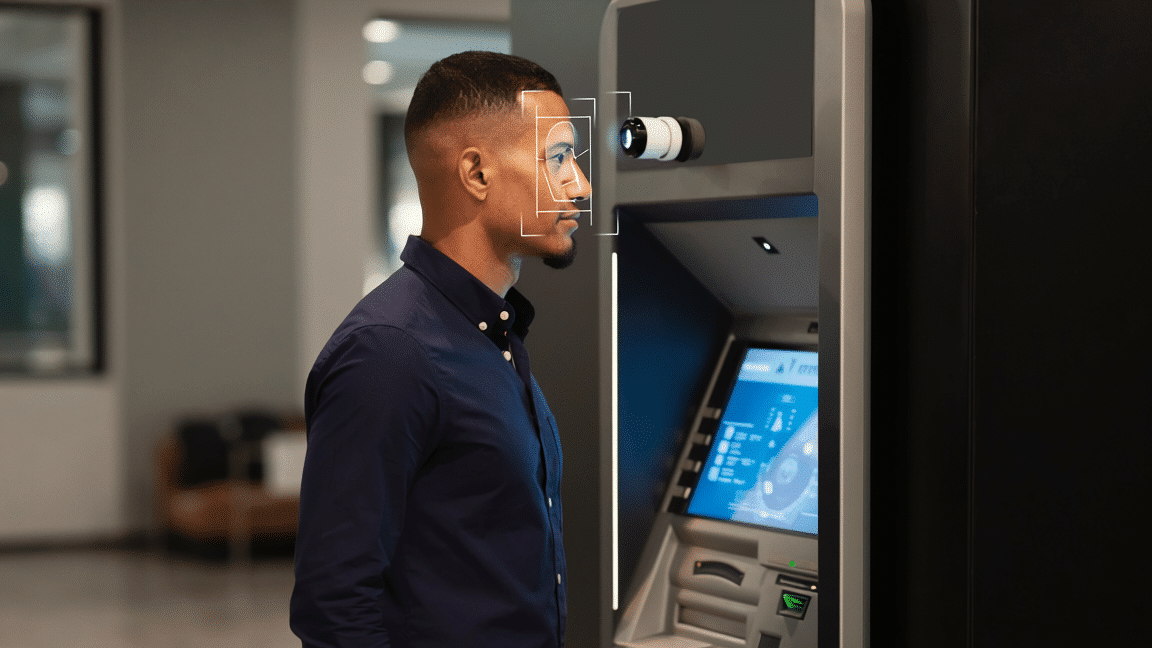
Once the ID is captured, the kiosk’s camera takes a live photo or short video of the user. Facial recognition software compares the live image against the photo on the scanned ID. This step confirms that the person holding the ID is the person pictured on it — not someone who found or stole the document.
Liveness Detection
Facial matching alone can be defeated by a photograph held up to the camera. Liveness detection closes that gap. Using AI analysis, the system determines whether the image it is seeing comes from a real, present human being, not a printout, a screen, or a mask. In some implementations, liveness detection is passive, analyzing subtle visual cues like skin texture and micro-movements. In others, it involves a simple prompted action: blink, turn your head slightly, or smile. Either way, the goal is the same, confirming that a live person is standing at the machine.
Database Cross-Validation
In many deployments, particularly those involving financial transactions, the verified identity is then checked against one or more external databases. These may include the U.S. Treasury’s Office of Foreign Assets Control (OFAC) watchlist, fraud registries maintained by identity verification providers, or proprietary databases operated by the kiosk software platform. For higher-value transactions, operators may also query identity verification services that cross-reference public records, credit header data, and other signals to confirm that the identity is real and not synthetic.
Together, these four layers form a verification stack that, when properly configured, completes in under 30 seconds. That threshold matters. Consumer research in self-service environments consistently shows that users will tolerate a brief pause for security purposes. What they will not tolerate is an extended wait. A 25-second verification is workable. A 90-second process produces abandonment.
It is worth noting that kiosk hardware manufacturers like Olea Kiosks do not develop or own the software that runs these verification processes. That software comes from specialized identity verification vendors and kiosk software platforms that operators select based on their specific use case, regulatory requirements, and transaction volumes. The hardware must be built to accommodate those software needs — the right cameras, scanners, and processing capability — but the verification intelligence lives in the software layer.
Why Speed Is No Longer the Tradeoff It Used to Be
Early self-service kiosks that handled cash or financial transactions often required manual identity review. For example, a human on the other end of a camera feed or a back-office team reviewing captured ID images after the fact. That approach was slow, inconsistent, and difficult to scale.
What changed is the maturation of edge AI processing, high-resolution document scanning hardware, and purpose-built identity verification software. Modern systems can analyze an ID document and perform a biometric match locally, on-device, in a fraction of the time it once took to send that data to a remote server and wait for a response. The accuracy of OCR on identity documents has also improved dramatically, reducing the failure rate that once caused verification to time out or require a retry.
The practical result is that a rigorous, multi-layer verification process now fits comfortably within the attention span of a user standing at a kiosk. The security hasn’t been reduced. The time required to achieve it has.
How Identity Verification Differs by Industry
Speed and accuracy are table stakes. What separates a well-deployed cash kiosk from a poorly-deployed one is whether the verification approach is calibrated to the specific regulatory, operational, and user experience requirements of the environment it operates in. Those requirements differ substantially across industries.
Financial Services and Check Cashing
Check-cashing kiosks and financial services kiosks operate under the most demanding regulatory framework of any cash kiosk deployment. The Bank Secrecy Act, FinCEN’s Know Your Customer (KYC) requirements, and Anti-Money Laundering (AML) rules all apply. Transactions above certain dollar thresholds trigger mandatory reporting obligations. Patterns of transactions designed to stay below those thresholds, a practice known as structuring, must also be detected and reported.
In this environment, identity verification must do more than confirm who the user is. It must also create a durable, auditable record of that confirmation. Financial regulations typically require that identity records be retained for five years or more. The verification system must therefore be both a security tool and a compliance data system, with records that can be produced on demand for regulatory examination.
Watchlist screening against OFAC and other sanctions databases is non-negotiable in this vertical. So is the ability to configure transaction limits by user tier — allowing more verification-intensive workflows to unlock higher transaction amounts.
Corrections and Reentry
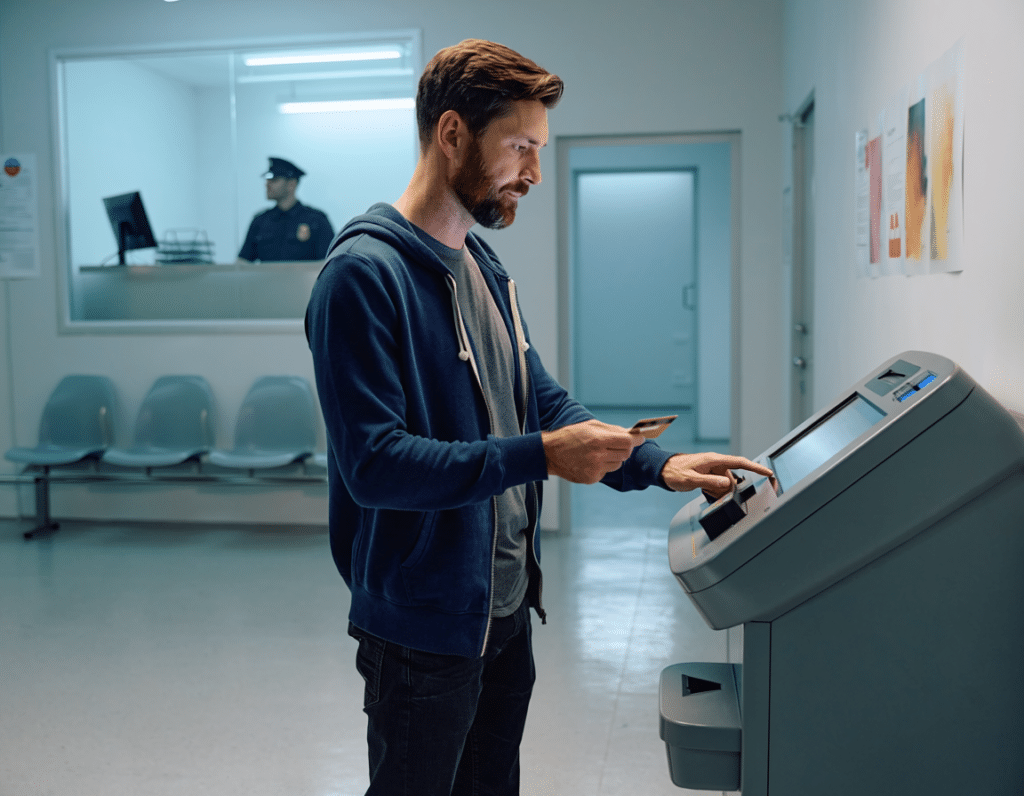
Cash kiosks deployed in correctional facilities and reentry programs face a different challenge entirely. The user population may include individuals with expired ID documents, individuals who have never held a standard government ID, or individuals whose identity must be verified against a facility-specific database rather than, or in addition to, standard government records.
In many corrections deployments, biometric enrollment happens at intake. Fingerprints or iris scans are captured and tied to the individual’s facility record. When that person is released and approaches a kiosk to receive funds, the verification step is biometric-first: the kiosk reads a fingerprint or iris scan and matches it to the enrollment record, bypassing the need for a government ID entirely.
This approach is more inclusive for a population that is often underserved by standard document-based verification, and it is more secure because biometric identifiers cannot be lost, borrowed, or forged the way a physical ID can.
Government Services and Benefits Disbursement
Kiosks that dispense government benefits or government-administered funds operate under federal identity assurance standards set by the National Institute of Standards and Technology (NIST). The relevant framework, NIST Special Publication 800-63, defines Identity Assurance Levels (IALs) that specify how rigorously an identity must be verified before access is granted to a given service.
Most cash disbursement applications in government contexts require IAL2. This level demands in-person or supervised remote identity proofing, with verification of a government-issued ID and a biometric binding. The kiosk, in this context, is functioning as a supervised identity proofing station, not just a transaction terminal.
Accessibility is a particularly acute concern in government deployments. The user population often includes elderly individuals, people with limited English proficiency, and people with low digital literacy. The verification UX must account for these users. It must offer language options, large-print interfaces, and verification flows that do not assume familiarity with smartphones or biometric processes.
Hospitality and Gaming
In hospitality and gaming environments, cash kiosks serve a population that expects speed and discretion above all else. A hotel guest seeking a cash advance and a casino patron converting chips to cash are not in a mindset that accommodates a lengthy identity process. The verification must be fast enough to feel like a natural part of the transaction, not an interrogation.
In gaming specifically, identity verification carries additional regulatory weight. State gaming commissions require that cash transactions above defined thresholds be tied to a verified identity for AML purposes. Many jurisdictions also require that kiosks screen users against self-exclusion registries. These are databases of individuals who have voluntarily or legally restricted their own access to gaming facilities. Facial recognition tied to those registries is increasingly common.
Age verification is a baseline requirement in both hospitality and gaming contexts. The verification stack must reliably confirm that the user meets minimum age requirements before any transaction proceeds.
Retail and Unbanked Consumer Services
Kiosks that serve unbanked and underbanked consumers — offering check cashing, money orders, bill payment, or cash withdrawals outside the traditional banking system — operate with somewhat lighter regulatory overhead than financial services kiosks, but with the highest UX sensitivity of any vertical.
Many users in this segment are unbanked by circumstance, not by choice. They may have had negative experiences with financial institutions, may distrust data collection, or may simply be unfamiliar with biometric verification. The verification process must be designed to feel transparent and non-threatening, with clear explanations of what is being captured, how long it is retained, and what it is used for.
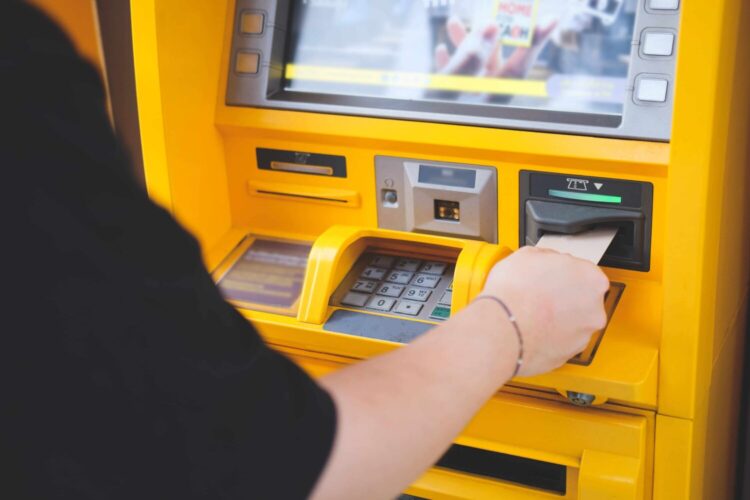
Verification depth in this vertical is often calibrated to transaction size. Smaller transactions may require only a document scan and a basic liveness check. Larger transactions trigger the full stack, including database cross-validation. This tiered approach balances fraud protection with user experience, knowing that one alternative is to simply walk away if the experience is lacking.
Questions Operators Should Ask Their Kiosk Partner
Choosing the right verification approach is not just a software decision or a hardware decision. It is a systems decision that spans both. When evaluating a cash kiosk deployment, operators should ask about the following:
Does the verification software meet the specific regulatory requirements of my vertical and state? Requirements vary not just by industry but by jurisdiction. A check-cashing kiosk in one state may face different threshold reporting requirements than the same kiosk deployed two states away.
Where is identity data stored, for how long, and under what security standard? Biometric data and identity records are sensitive. Operators need to understand exactly where that data lives, who can access it, and how it is protected.
What happens when verification fails? A user who cannot pass verification still needs a path forward. In some cases, that might mean a fallback to a human-assisted process, a different form of ID, or a clear explanation of why the transaction cannot proceed.
Can verification thresholds be configured by transaction type or amount? A flexible verification stack that scales depth with transaction risk is both more user-friendly and more compliant than a one-size-fits-all approach.
Is liveness detection included, or only static facial matching? The answer to this question has significant implications for fraud exposure. Static facial matching alone is insufficient in any high-value transaction environment.
Conclusion: The 30-Second Window of Trust
The engineering problem that once made self-service cash transactions feel inherently risky has largely been solved. A verification process that used to require a human reviewer, a paper form, and several minutes now happens at a kiosk in under half a minute, with greater consistency, a cleaner audit trail, and no risk of human error or bias in the matching step.
But deploying a cash kiosk with the right verification stack is not simply a matter of turning on the fastest or most feature-rich software available. Trust is contextual. A corrections facility and a hotel casino are both deploying cash kiosks, and their users, their regulators, and their risk profiles could not be more different. The operators who take the time to understand those differences — and who work with kiosk partners experienced enough to help them navigate them — are the ones who will see adoption, regulatory confidence, and user trust align.
As AI-driven document recognition and biometric standards continue to mature, the gap between “fast enough” and “rigorous enough” will keep narrowing. The 30-second window of trust will become 20 seconds. Then 15. The underlying principle, however, will remain constant: cash may be anonymous by nature, but the machine dispensing it never has to be.
Olea Kiosks designs and manufactures self-service kiosk hardware for a wide range of industries. Olea works with best-in-class software partners to deliver complete kiosk solutions — including identity verification — tailored to the regulatory and operational requirements of each deployment. To learn more about Olea’s cash-handling kiosk solutions, visit oleakiosks.com.