
Most self-service programs in banking start the same way. A financial institution picks a vendor, runs a pilot, and the numbers look great. Transactions are up. Wait times are down. Customers seem happy.
Then year two arrives.
Devices start going dark in the field. Support calls pile up. Someone is dispatching technicians to locations spread across a large geography — reacting to problems instead of preventing them. And somewhere in a conference room, a technology leader is explaining why a program that looked so promising is now costing more than expected to keep running.
The hardware worked. The deployment didn’t.
This is the mistake that plays out across financial services more than most people talk about. Banks and credit unions are making what they think is a hardware decision. What they’re actually making is an infrastructure decision — and they don’t realize it until it’s expensive.
Bigger Deployments Reveal Bigger Problems
There’s a big difference between running ten kiosks and running a hundred. And there’s an even bigger difference between deploying a hundred and operating a hundred — across branches, retail locations, and remote sites — for the next four years.
Wells Fargo is a useful example of what scaling self-service actually looks like. What started as a strong pilot in San Francisco — more self-service transactions, shorter lines, happy customers — earned enough confidence to trigger a nationwide rollout spanning thousands of branches. The concept was proven. The customer demand was real. And the scale of the commitment that followed made one thing clear: deploying kiosks at that level isn’t a technology project. It’s an operational infrastructure decision that touches staffing, support, security, and systems integration across every location in the network.
Most institutions don’t think about kiosk lifecycle management until they’re already in it. The ones that do think about it upfront build programs that hold up. The ones that don’t spend year two fixing problems they didn’t know to plan for.
Three Places Where Financial Services Kiosk Deployments Break Down
For anyone responsible for deploying self-service technology across a large financial network, the risk isn’t whether kiosks work. They do. The risk lives in three specific gaps that almost never come up in a vendor demo.
Uptime is a compliance issue, not just an operations issue.
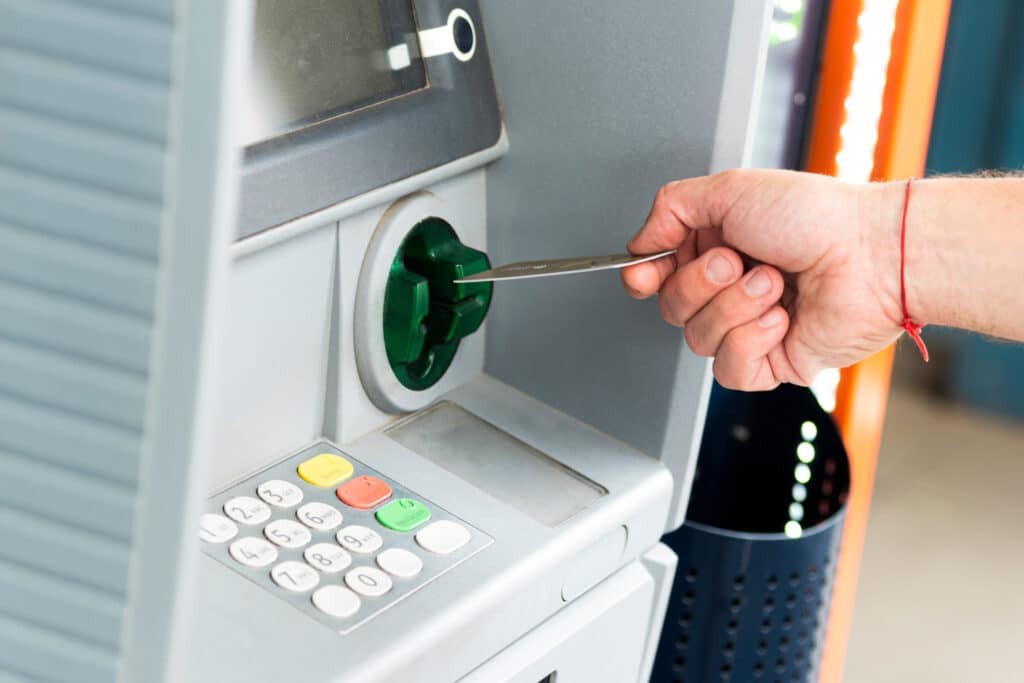
When a kiosk handles identity verification, instant card issuance, cash deposits, and real-time approvals, a device going offline isn’t just inconvenient. It’s a broken promise to a customer who came specifically to complete a financial transaction. In a high-traffic retail environment — where a single location might see tens of thousands of visitors each week — that failure is happening in public, at volume, with your brand on it.
Smart institutions don’t just ask vendors for uptime numbers. They ask how uptime is built — remote monitoring, over-the-air software updates, predictive alerts that catch problems before they cause downtime, and the ability to disable a compromised device remotely without sending someone on-site. The gap between 97% uptime and 99% uptime sounds small. Across a fleet of 200 devices, it’s the difference between a manageable program and one that’s constantly on fire.
Serviceability has to be designed in from the start.
Every vendor will tell you their financial services kiosk deployments are easy to service. The question is whether they designed it that way from day one or figured it out afterward. When a card printer fails or a bill acceptor jams, the clock starts immediately — not just on the customer experience, but on the repair time commitments written into enterprise service agreements.
Modular components, simple access for routine maintenance, clearly designed replenishment points for card stock and cash — these aren’t nice-to-have features. They’re what separates a technician resolving an issue in under an hour from a device sitting offline for two days. If you’re running kiosks in standalone retail locations or 24/7 sites with no on-site staff, remote reliability isn’t a feature you evaluate. It’s a requirement you build around.
Integration complexity shows up after the contract is signed.
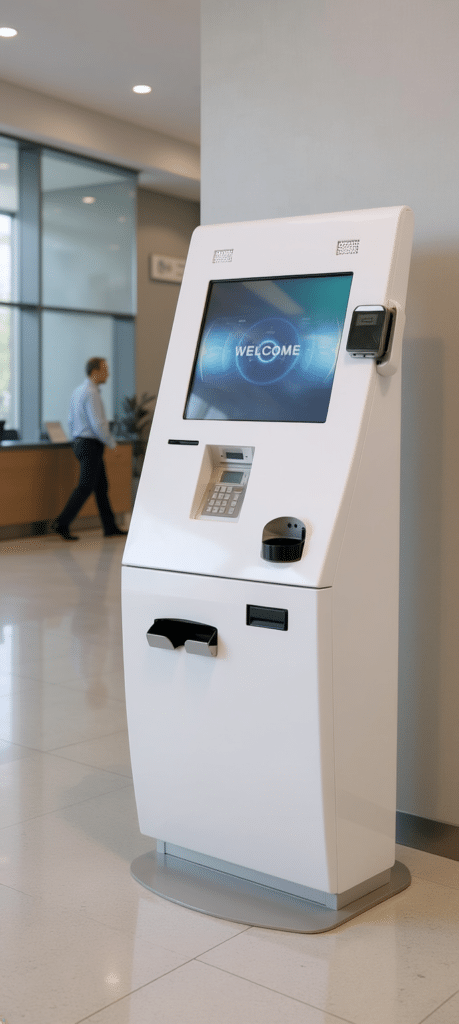
Digital transformation for financial institutions is complex and disrupting the whole business model and the operation. A modern financial kiosk isn’t really a kiosk. It’s an integration challenge with a touchscreen on the front. A full-service device today needs to coordinate identity verification, AML screening (Anti-Money Laundering), core banking connections, EMV card encoding, cash handling hardware, fraud detection, and remote monitoring — all in sequence, in real time, with a full audit trail on every transaction.
The institutions that run into trouble aren’t the ones that underestimated the hardware. They’re the ones that showed up to the integration phase with a list of “compatible” third-party components and no proven architecture connecting them. One regional credit union that moved nearly 90% of routine transactions to kiosks — freeing staff to focus entirely on loans, advice, and member relationships — only got there because the core banking integration was solid from day one. Partial integration leads to partial adoption. And partial adoption means the business case never fully closes.
The Question That Changes Everything
The financial institutions that get self-service right at scale have made one important mindset shift. They stopped asking “which kiosk should we buy?” and started asking “what does our self-service operation need to look like in year four?”
That one question changes everything downstream.
It changes how you evaluate vendors — not just on design and specs, but on ecosystem depth, integration experience, and remote management capability. It changes how you write contracts — not around launch performance, but around lifecycle uptime and defined repair time targets. It changes how you think about the device itself — not as a product you’re purchasing, but as infrastructure you’re committing to operate.
And it changes what a red flag looks like. A kiosk that looks great in a showroom but was built without modular serviceability, without remote diagnostic tools, and without a pre-integrated technology stack isn’t really a kiosk. It’s a future maintenance problem.
Built for the Long Run
A regional credit union with financial services kiosks deployments across its locations recovered 45 hours of staff time per week. Not by buying the most technically sophisticated device on the market — but by deploying one that worked reliably enough, consistently enough, to shift real transaction volume off their staff and keep it there. The technology made it possible. Operational reliability made it last.
That’s the model worth building toward. And doing it across a large retail footprint — with complex compliance requirements, high transaction volume, and a consumer brand that needs to look and feel right in every location — takes a partner who was thinking about year four when they designed the device, not just launch day.
The right partner brings hardware built to be serviced quickly in the field. A pre-integrated ecosystem of identity, payment, connectivity, and peripheral components. Remote monitoring that gives your operations team visibility across every device in the network. And the design capability to make sure the kiosk doesn’t just work reliably — it looks like it belongs in the environment it’s deployed in.
The kiosk is what your customers see. The infrastructure is what keeps it working.
The Conversation Worth Having Before You Buy
Before your next self-service evaluation, there’s one question worth asking every vendor in the room: If we deploy 200 of these devices across our network, what does our operations team look like in year three?
The vendors who can answer that with specifics — remote monitoring tools, serviceability documentation, integration ecosystem depth, and real deployments still performing at launch-day levels — are building infrastructure.
Everyone else is selling hardware. Olea Kiosks has spent 50 years designing and manufacturing self-service systems built to perform over the long haul. From identity and payment integration to remote fleet management and field serviceability, Olea partners with financial institutions that are building self-service infrastructure — not just buying devices. If you’d like to talk to one of our team members regarding your next financial services deployment, click here.