Most rural healthcare administrators are aware that the Rural Health Transformation Program (RHTP), the $50 billion, five-year federal initiative established under the One Big Beautiful Bill Act, is now distributing funds to all 50 states. There is a direct line between RHTP’s stated goals and the specific technologies those goals are designed to fund.
Centers for Medicare & Medicaid Services (CMS) language like “consumer-facing technology-driven solutions” and “significant information technology advances” can obscure what is actually on the eligible investment list. This article cuts through that language.
Three technology categories align directly with RHTP’s framework, generate the measurable outcomes grant applications require, and address the access gaps rural communities are experiencing right now: patient check-in modernization and on-site telehealth endpoints with diagnostic integration. Each is deployable today and qualifies under multiple RHTP strategic goals.
A disclosure: Olea Kiosks manufactures the category of technology this article describes. We have been in business for over 50 years and worked with more than 200 health systems and have a clear interest in rural providers modernizing patient access. We have tried to write the analysis we would want to read if we were on the other side of this decision.
The Funding Moment
Year 1 RHTP awards are averaging $200 million per state, with all 50 states receiving funds. The money is 100% federally sourced — no state match required. It flows from CMS to state agencies, which then design their own subaward processes: competitive grants, RFPs, and direct contracts with eligible providers.
Technology investments are explicitly eligible under RHTP’s fifth strategic goal — Technology Innovation — which covers telehealth, remote monitoring, AI, cybersecurity, and digital health tools. But technology investments can simultaneously address Goals 1 through 4 as well, which matters because CMS requires funded activities to align with at least three goals. A well-constructed technology proposal can satisfy that threshold on its own.
How Providers Access Funds
Providers apply through their state RHTP program office, not directly to CMS. States are at different stages: some have opened competitive grant rounds already; others are still finalizing frameworks. Download your state’s approved transformation plan and contact the lead agency now. Stakeholder engagement before rounds open could meaningfully improve competitive position.
Patient Check-In Modernization
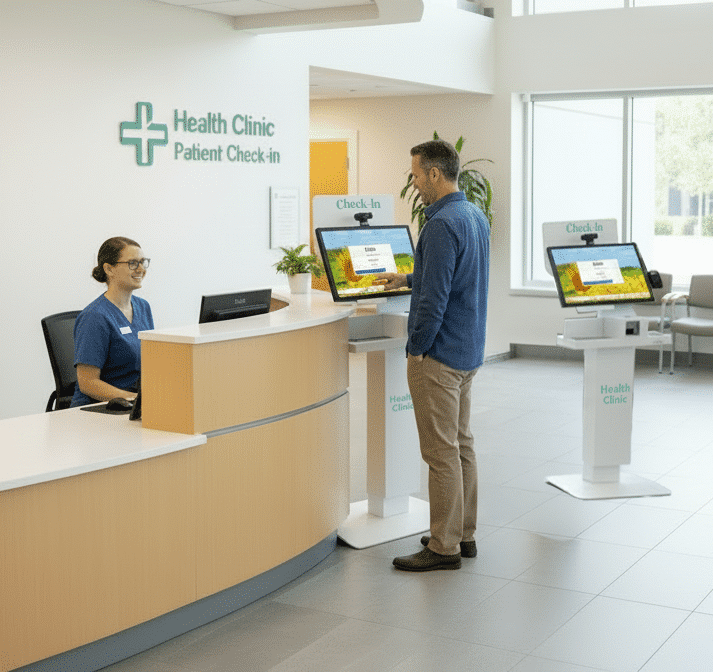
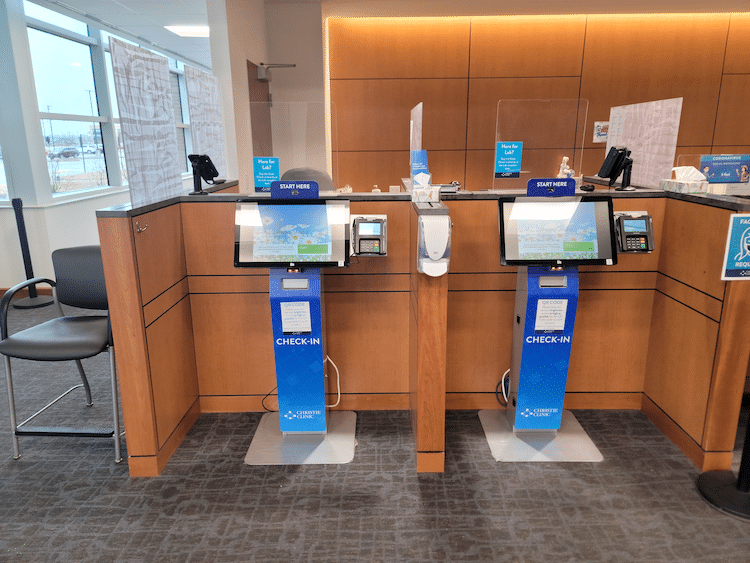
The registration desk is one of the most visible operational bottlenecks in rural healthcare. In facilities where a single front-desk employee handles intake, phones, and insurance verification simultaneously, manual check-in consumes clinical bandwidth that cannot be recovered. The administrative front end of the visit — demographic verification, consent forms, copay collection, and queuing — is the right target for automation.
Self-service check-in kiosks handle these tasks independently, freeing staff for higher-complexity clinical support. The following outcomes are based on data from Olea deployments across 200+ health systems that have deployed this technology:
| <1 min Check-in | 67% Faster | +1,500% Collections | 81% Senior adoption |
The collections figure above deserves attention: one healthcare system saw balance collection improve by 1,500% within two weeks of deployment. This was driven by built-in payment prompts patients encounter during self-check-in. For rural facilities facing thin margins, this is operational sustainability, not just efficiency.
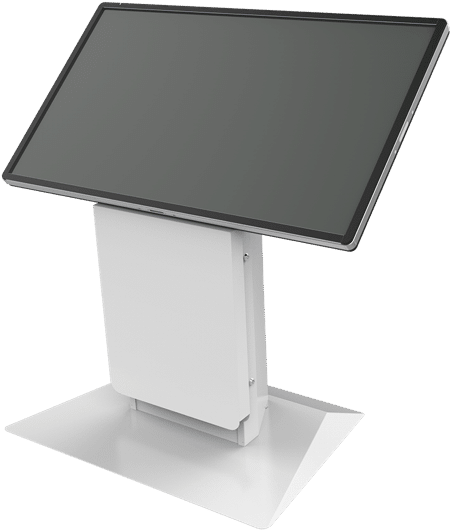
ADA Compliance Consideration: Federal standards now require self-service interfaces to be independently usable by patients with visual or physical impairments, not just accessible with staff assistance. Hardware must include audio navigation, tactile keyboards, and height-adjustable screens. Olea’s Chicago Healthcare Check-In Kiosk was engineered specifically to meet this standard, incorporating the STORM Audio NAV system and an integrated keyboard alongside ADA-compliant height adjustment. Verify that any technology under consideration meets these requirements before submitting a grant application.
Grant ROI framing: For grant application purposes, the ROI case for check-in modernization rests on two quantifiable outcomes: staff time reallocated from administrative to clinical tasks, and collections recovered at the point of service. Both are measurable from day one of deployment, and both map directly to RHTP’s sustainability reporting requirements. Olea can provide facility-specific projections to support your application.
On-Site Telehealth Endpoints
Access to specialists is the defining rural healthcare gap. When the choice is between a 90-minute drive and no care at all, the outcome is predictable. On-site telehealth endpoints change that by bringing the specialist encounter to the patient, at the clinic, on-demand, without adding permanent headcount.
Clinical-grade telehealth endpoints are not consumer video calls. They are purpose-built kiosks and stations that integrate HD cameras, speakers, privacy enclosures, and a suite of diagnostic peripherals that allow a remote clinician to gather real clinical data in real time. Configured platforms support blood pressure monitoring, SpO2, temperature, weight, ECG, and glucose measurement.
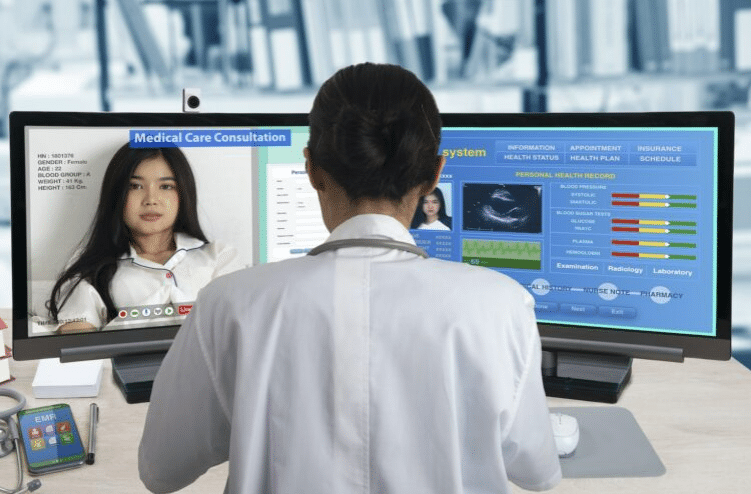
A telehealth endpoint deployment is among the most efficient uses of RHTP funds from a goal-alignment standpoint: a single project can credibly address Technology Innovation, Sustainable Access, Chronic Disease Management, and Behavioral Health, four of CMS’s five strategic goals, within one budget line.
Workforce Extension Through Self-Service
RHTP’s workforce development goal is typically read as recruitment and retention. But it also encompasses helping providers practice at the top of their license which means removing administrative burden from clinical roles. In rural facilities where staffing is perpetually constrained, this framing opens a direct path for self-service technology to qualify under the workforce goal as well.
Self-service kiosks fully integrated with Epic Welcome or any EMR via platforms like Lifemed automate the intake workflow end-to-end: demographic validation, insurance confirmation, consent form collection, and payment capture. Patients complete these tasks independently, with higher accuracy than manual entry and no additional labor cost. The workflow creates a documented, auditable record that satisfies RHTP’s reporting requirements. The staff time recaptured goes directly back to patient care.
When framing this technology investment as a workforce multiplier, it’s one of the strongest arguments available to rural facilities writing RHTP technology funding applications, because it connects infrastructure spending directly to the clinical mission rather than treating it as a back-office upgrade.
The Next Step
Federal rural health investment at this scale is rare. The window to shape how those funds are deployed and to position your organization as a recipient, is open now, but it will not remain open indefinitely. State grant rounds are launching on rolling timelines throughout 2026.
The question worth asking internally is not whether these technologies are interesting. It is whether your facility has the access gaps they address — manual registration bottlenecks, specialist shortages, clinical staff consumed by administrative tasks — and whether those gaps can be documented, quantified, and connected to the RHTP goals your state has prioritized. If the answer is yes, the RHTP technology funding path is available.